
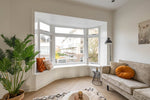
XL herringbone vinyl with a dog: beautiful and practical?
, by Michael van Wassem, 4 min reading time
, by Michael van Wassem, 4 min reading time
XL herringbone vinyl combines a luxury herringbone look with a matte, water-resistant top layer. What does that mean with a dog, and what should you check on seams, installation and colour?
XL herringbone vinyl is the larger, calmer sibling of herringbone: longer, wider planks in the same zigzag pattern. It looks luxurious, but with a dog you want to know more than whether it is pretty. Can it handle paws, nails and mud?
Yes, XL herringbone can work well with a dog, especially when it is glued down. A matte, water-resistant vinyl floor with a 0.55 mm wear layer copes with daily life. The drawback is the pattern: there are more seams than with tiles or wide planks, and hair and dirt collect in them. No floor is completely scratch-proof or slip-proof.
XL herringbone planks measure about 91 × 15 cm, while standard herringbone is smaller (roughly 61 × 12 cm). The larger format makes the pattern look calmer, especially in a big living room. Good products have a tactile wood structure and a matte finish that reflects little light. Always check the product data for water resistance and underfloor heating.
Every plank has an edge, and a herringbone pattern has many. Hair, sand and dried mud get stuck in the seams more easily than on a tile or wide plank. If your dog sheds a lot, vacuum a little more often. A soft brush or a vacuum with a parquet nozzle works better than a hard broom. A mid-tone such as oak or greige shows hair and dust less.
| Glued | Click | |
|---|---|---|
| Sound | Quieter, fixed to the subfloor | Floating, nails are heard sooner |
| Installation | Needs an even subfloor and adhesive | Often DIY-friendly, on a suitable underlay |
For the most calm and stability, choose glued. If you install it yourself, click is a good option as long as you do not skip the right underlay.
Herringbone needs more cutting waste than straight planks, because you work diagonally along the walls. Plan for 5 to 15%. Take a living room of 20 m² and a pack of about 3.3 m²:
Floors are sold in whole packs. A room with many corners, alcoves or stairs can need more, so use the highest percentage.
Mid-tones such as natural oak or greige hide hair, dust and dried mud best. Pale cream shows dark hair, dark brown shows light hair. Look at a sample where your dog lies, in daylight and in lamplight.
Extra grip reduces the chance of slipping, but does not rule it out. When playing, running or jumping, a dog can slip on any floor. Stay careful, especially with puppies, older dogs and dogs with joint problems. Keep nails short and consider a rug where your dog often plays or gets up. If you notice limping or pain, see your vet.
Be realistic about scratches too. A strong wear layer helps, but nails leave marks on any floor over time.
A matte finish gives more grip than a glossy one, but no floor is slip-proof. See the section on grip above.
A little. Hair and sand stay in the seams more easily. Regular vacuuming and a lightly damp mop usually solve that.
Many vinyl floors can, but check the specifications of the exact product.
XL herringbone vinyl is attractive, water-resistant and available with extra grip. With a dog, glued is usually the better choice, plan generously for cutting waste and vacuum the seams a little more often.
⭐ Add Fidello as a preferred source on Google


